Why Homemade Ghee Is Having a Global Moment – And How to Make It with Village Masala Butter
For decades, ghee was on the wrong side of dietary advice — lumped in with other saturated fats and told to stay out of modern kitchens. Then the science caught up with what Indian grandmothers had been saying all along. Ghee is not just safe — it is beneficial. Rich in fat-soluble vitamins, conjugated linoleic acid (CLA), and butyrate, it is now embraced by everyone from Paleo and keto dieters to Ayurvedic practitioners and Michelin-starred chefs. At Village Masala, our pure desi ghee is made from the finest quality cream — but we also want to teach you to make it yourself.
The Science Behind Ghee’s Revival
Ghee is clarified butter — butter from which all the milk solids and water have been removed by slow heating. This process changes the fat profile in meaningful ways. The butyric acid in ghee supports gut health by feeding the cells lining the colon. The fat-soluble vitamins A, D, E, and K2 are present in concentrations that make ghee a genuinely nutritious fat, especially for those on low-carb diets where fat is the primary fuel.
Ghee also has a high smoke point of around 250°C — significantly higher than butter or most vegetable oils — making it ideal for high-heat cooking without oxidation. It is naturally lactose-free and casein-free, as these milk proteins are removed during clarification, which is why many dairy-sensitive people can tolerate ghee without issues.
“Ghee has been used in Indian Ayurvedic medicine for over 5,000 years as a digestive aid, a cooking fat, and a carrier for herbal medicines. Modern science has confirmed what ancient practitioners knew: the butyrate in ghee directly nourishes the cells of the gut lining”
How to Make Perfect Homemade Ghee
Making ghee at home takes about 30 minutes and requires only one ingredient: high-quality unsalted butter. Use the best butter you can find — ideally cultured or grass-fed, as the flavour of the final ghee depends entirely on the quality of the butter.
Melt the butter in a heavy-bottomed pan over medium-low heat. It will begin to bubble as the water evaporates — this is normal and expected. After about 10 minutes, the foam will thicken on the surface; skim it off gently. Continue cooking until the milk solids at the bottom turn golden-brown and the ghee turns clear with a deep amber colour. The whole kitchen will smell like popcorn and caramel — this is the Maillard reaction working on the milk solids. Strain through a fine mesh or cheesecloth into a clean glass jar. The ghee will be liquid when hot and solidify to a beautiful golden colour as it cools.
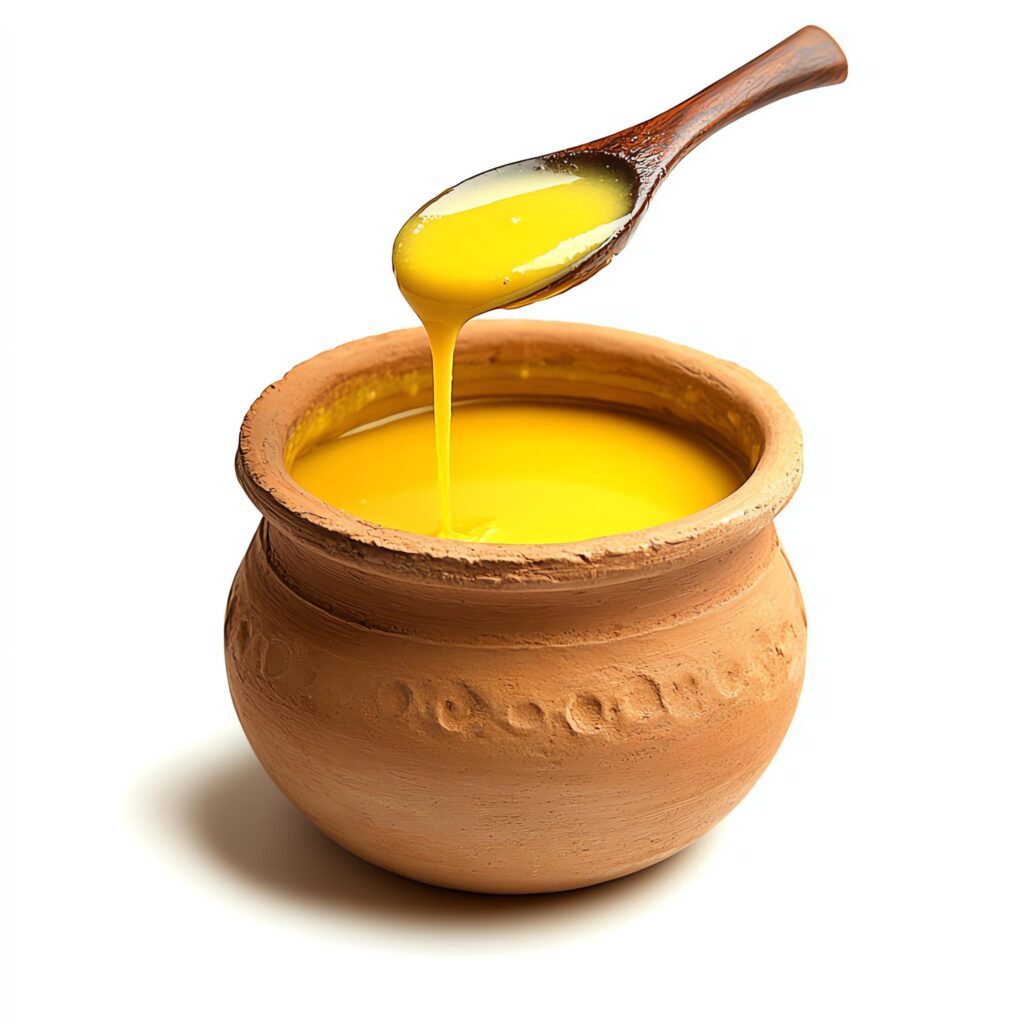
The quality of your ghee is determined entirely by the quality of your butter. Village Masala’s pure desi ghee is made from the cream of grass-fed cows, slow-clarified in the traditional method — delivering a richer, more aromatic ghee than anything available in a Western supermarket.
Cooking with Ghee: Beyond the Dal
Most people know ghee as the finishing touch drizzled over hot dal or biryani — and it excels at this role. But ghee’s versatility goes much further. Use it to roast vegetables at high heat — they develop a more complex, caramelised flavour than with any other fat. Make your morning eggs in ghee for a richer, more flavourful result.
Ghee is also the fat of choice for traditional Indian sweets — halwa, ladoo, and mysore pak all depend on ghee for their characteristic richness. It can replace butter in most baking applications, producing baked goods with a deeper flavour. And a small spoonful of ghee stirred into hot rice with a pinch of salt is, arguably, one of the greatest simple pleasures in Indian food.